
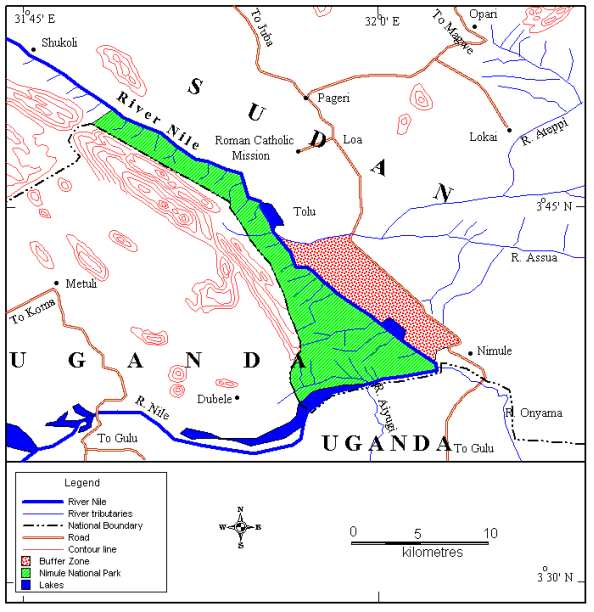
This study was based on bird surveys of Nimule National Park (NNP), South Sudan. The surveys were conducted from May to August 2009, January to April 2010, and May 2010, and in subsequent years during January and February of 2024 and 2025, as well as in August 2026, covering both the wet and dry seasons. Attempts were made to sample all three (3) habitat types of NNP, which include riverine, grassland, and woodland savannah. The rationale of the study was to establish a checklist of birds for NNP and its surrounding environments. The line transect method using random sample points was adapted for recording all birds cited or heard during the surveys. We recorded 172 bird species during the study, of which 9 species are Afro-Palearctic song birds and 12 species of Palearctic waterbirds that breed in Europe/Asia and winter in Africa. At least 4 species are endangered and 1 species is critically endangered. A total of 81 species are likely new records that did not appear in previous studies. Based on our observations together with the previous two unpublished bird checklists, a cumulative total of 228 distinct bird species have so far been documented within the park territory and its immediate buffer zone. It is therefore believed that the recent increase in the number of birds encountered in the study area could be due to either migration or seasonal changes, during which the surveys were conducted. The findings from the bird surveys in Nimule National Park highlight a diverse avian community comprising 173 species, including significant numbers of Afro-Palearctic songbirds and Palearctic waterbirds. The identification of 81 likely new records underscores the ecological importance and dynamic nature of the park’s habitats. When combined with previous unpublished checklists, the cumulative total of 228 recorded species reflects both seasonal variations and migratory influxes. These results emphasize the need for continued monitoring to better understand temporal patterns and support conservation efforts within NNP and its surrounding environments.
| Published in | International Journal of Natural Resource Ecology and Management (Volume 11, Issue 4) |
| DOI | 10.11648/j.ijnrem.20261104.12 |
| Page(s) | 157-166 |
| Creative Commons |
This is an Open Access article, distributed under the terms of the Creative Commons Attribution 4.0 International License (http://creativecommons.org/licenses/by/4.0/), which permits unrestricted use, distribution and reproduction in any medium or format, provided the original work is properly cited. |
| Copyright |
Copyright © The Author(s), 2026. Published by Science Publishing Group |
Avian Biodiversity, Bird Species Checklist, Nimule National Park, South Sudan, Bird Surveys, Migratory Birds, Palearctic Migrants
No. | Common name | Scientific name |
|---|---|---|
1 | White-faced Whistling-Duck | Dendrocygna viduata (Linnaeus, 1766) |
2 | Fulvous Whistling-Duck | Dendrocygna bicolor (Gmelin, 1789) |
3 | Vinaceous Dove | Streptopelia vinacea (Gmelin, 1789) |
4 | Emerald-spotted Wood-Dove | Turtur chalcospilos (Wagler, 1827) |
5 | Eastern Plantain-eater | Crinifer zonurus (Ruppell, 1827) |
6 | Great Spotted Cuckoo | Clamator glandarius (Linnaeus, 1758) |
7 | Alpine Swift** | Tachymarptis melba (Linnaeus, 1758) |
8 | Little Swift** | Apus affinis (Gray, 1780) |
9 | African Crake | Crecopsis egregia (Peters, 1854) |
10 | Black Crake | Zapornia flavirostra (Swainson, 1837) |
11 | Senegal Thick-knee | Burhinus senegalensis (Swainson, 1837) |
12 | African Wattled Lapwing | Vanellus senegallus (Linnaeus, 1766) |
13 | African Skimmer | Rynchops flavirostris (Vieillot, 1816) |
14 | Reed Cormorant | Microcarbo africanus (Gmelin, 1789) |
15 | Great Cormorant | Phalacrocorax carbo (Linnaeus, 1758) |
16 | Blue-naped Mousebird | Urocolius macrourus (Linnaeus, 1766) |
No. | Common name | Scientific name |
17 | Common Hoopoe | Upupa epops (Linnaeus, 1758) |
18 | African Gray Hornbill | Lophoceros nasutus (Linnaeus, 1766) |
19 | Red-throated Bee-eater | Merops bulocki (Vieillot, 1817) |
20 | Swallow-tailed Bee-eater | Merops hirundineus (Lichtenstein, 1793) |
21 | D'Arnaud's Barbet | Trachyphonus darnaudii (Pre’vost & Des Murs, 1847) |
22 | Yellow-rumped Tinkerbird | Pogoniulus bilineatus (Sundvall, 1850) |
23 | Northern Red-fronted Tinkerbird | Pogoniulus uropygialis (Heuglin, 1862) |
24 | Black-breasted Barbet | Pogonornis rolleti (De Filippe, 1853) |
25 | Cardinal Woodpecker | Dendropicos fuscescens (Vieillot, 1818) |
26 | African Gray Woodpecker | Dendropicos goertae (Muller, PLS, 1776) |
27 | Nubian Woodpecker | Campethera nubica (Boddaert, 1783) |
28 | Gray Kestrel | Falco ardosiaceus (Vieillot, 1823) |
29 | Black Cuckooshrike | Campephaga flava (Vieillot, 1817) |
30 | Red-shouldered Cuckooshrike | Campephaga phoenicea (Latham, 1790) |
31 | Brown-crowned Tchagra | Tchagra australis (Smith, 1836) |
32 | Green-backed Camaroptera | Camaroptera brachyura (Vieillot, 1821) |
33 | Eurasian Blackcap** | Sylvia atricapilla (Linnaeus, 1758) |
34 | Greater Whitethroat** | Curruca communis (Latham, 1767) (Latham, 1787) |
35 | Ruppell's Starling | Lamprotornis purpuroptera (Ruppel, 1845) |
36 | Superb Starling | Lamprotornis superbus (Ruppell, 1845) |
37 | Purple Starling | Lamprotornis purpureus (Statius Muller, 1776) |
38 | Western Yellow Wagtail | Motacilla flava (Linnaeus, 1758) |
39 | African Pipit | Anthus cinnamomeus (Rupell, 1840) |
40 | Tree Pipit | Anthus trivialis (Linnaeus, 1758) |
41 | Gray-headed Kingfisher | Halcyon leucocephala (Statius Muller, 1776) |
42 | Common Reed Warbler** | Acrocephalus scirpaceus (Hermann, 1804) |
43 | Common Redstart** | Phoenicurus phoenicurus (Linnaeus, 1758) |
44 | Beautiful Sunbird | Cinnyris pulchellus (Linnaeus, 1766) |
45 | Common Greenshank** | Tringa nebularia (Gunnerus, 1767) |
46 | Dwarf Bittern | Botaurus sturmii (Wagler, 1827) |
47 | Little Bittern | Botaurus minutus (Linnaeus, 1766) |
48 | Great Egret** | Ardea alba (Linnaeus, 1758) |
49 | Hamerkop | Scopus umbrette (Gmelin, 1789) |
50 | Osprey** | Pandion haliaetus (Linnaeus, 1758) |
51 | Hooded Vulture | Necrosyrtes monachus (Temmink, 1823) |
52 | Dark Chanting-Goshawk | Melierax metabates (Heuglin, 1861) |
53 | Greater Swamp Warbler | Acrocephalus rufescens (Sharpe & Bouvier, 1877) |
54 | Bruce's Green-Pigeon | Treron waalia (Meyer, 1793) |
55 | African Blue Flycatcher | Elminia longicauda (Swainson, 1838) |
56 | Gray-capped Warbler | Eminia lepida (Hartlaub, 1881) |
57 | Mountain Yellow-Warbler | Iduna similis (Richmond, 1897) |
58 | Sedge Warbler** | Acrocephalus schoenobaenus (Linnaeus, 1758) |
59 | Swamp Flycatcher | Muscicapa aquatica (Heuglin, 1864) |
60 | Northern Double-collared Sunbird | Cinnyris reichenowi (Sharpe, 1891) |
61 | Common Sandpiper** | Actitis hypoleucos (Linnaeus, 1758) |
No. | Common name | Scientific name |
62 | Yellow-fronted Tinkerbird | Pogoniulus chrysoconus (Temmink, 1832) |
63 | Black-Billed Barbet | Lybiu guifsobalalito (Hermann, 1783) |
64 | Bateleur | Terathopius ecaudatus (Daudin, 1800) |
65 | Little Bee-eater | Merops pusillus (Muller, 1776) |
66 | Northern Carmine Bee-eater | Merops nubicus (Gmelin, 1788) |
67 | Black-winked Bishop | Euplectes hordeaceus (Linnaeus, 1753) |
68 | Northern Red (orange) Bishop | Euplectes franciscanus (Isert, 1789) |
69 | Common Bulbul | Pycnonotus barbatus (Desfontaine, 1789) |
70 | Winding Cisticola | Cisticola marginatus (von Heuglin, 1869) |
71 | Red-cheeked CordonBleu | Uraeginthus bengalus (Linnaeus, 1766) |
72 | Long-tailed Cormorant | Phalacrocorax africanus (Gmelina, 1789) |
73 | White-breasted Cormorant | Phalacrocorax lucidus (Lichtenstein, 1823) |
74 | Senegal Coucal | Centropus senegalensis (Linnaeus, 1766) |
75 | Grey Crowned Crane | Balearica regulorum (Bennett, 1834) |
76 | Pied Crow | Corvus albus (Müller, 1776) |
77 | African Mourning Dove | Streptopelia decipiens (Hartlaub & Finsch, 1870) |
78 | Cape Turtle (Ringed-Necked) Dove | Streptopelia capicola (Sundevall, 1857) |
79 | Laughing Dove | Streptopelia senegalensis (Linnaeus, 1766) |
80 | Red-eyed Dove | Streptopelia semitorquata (Rüppell, 1837) |
81 | Namaqua Dove | Oenaca pensis (Linnaeus, 1766) |
82 | African Darter | Anhinga rufa (Daudin, 1802) |
83 | African Fish-Eagle | Haliaeetus vocifer (Daudin, 1800) |
84 | Long Crested Eagle | Lophaetus occipitalis (Daudin, 1800) |
85 | Martial Eagle | Polemaetus bellicosus (Daudin, 1800) |
86 | Little Egret | Egretta garzetta (Linnaeus, 1766) |
87 | Greater White Egret | Ardea alba (Linnaeus, 1758) |
88 | Yellow-billed Egret | Egretta intermedia (Wagler, 1827) |
89 | Cattle Egret | Bubulcus ibis (Linnaeus, 1758) |
90 | Spotted Flycatcher ** | Muscicapa striata (Pallas, 1764) |
91 | Helmeted Guineafowl | Numida meleagris (Linnaeus, 1758) |
92 | White-billed Go-Away Bird | Corythaixoides leucogaster (Smith, 1833) |
93 | African Firefinch | Lagonosticta rubricate (Lichtenstein, 1823) |
94 | Red-billed Firefinch | Lagonosticta Senegala (Linnaeus, 1766) |
95 | African Pygmy Falcon | Polihierax semitorquatus (Smith, 1836) |
96 | African Paradise Flycatcher | Terpsiphone viridis (Müller, 1776) |
97 | Crested Francolin | Dendroperdix sephaena (Gmelin, 1789) |
98 | African Goshawk | Accipiter tachiro (Daudin, 1800) |
99 | Dark Chanting Goshawk | Melierax metabates (Heuglin, 1861) |
100 | Eastern Chanting Goshawk | Melicrax polipterus (Cabanis, 1868) |
101 | Gabar goshawk | Melierax gabar (Daudin, 1800) |
102 | Black-headed Gonolek | Laniarius erythrogaster (Cretzschmar, 1829) |
103 | Egyptian Goose | Alopochen aegyptiaca (Linnaeus, 1766) |
104 | Lesser Black-backed Gull ** | Larus fuscus (Linnaeus, 1758) |
105 | Hamerkop | Scopus umbrette (Gmelin, 1789) |
106 | Pallid Harrier | Circus macrourus (African Bird Club Checklist 2004) |
No. | Common name | Scientific name |
107 | Black-headed Heron | Ardea melanocephala (Vigors & Children, 1826) |
108 | Goliath Heron | Ardea goliath (Cretzschmar, 1827) |
109 | Purple Heron | Ardea purpurea (Linnaeus, 1766) |
110 | Squacco Heron | Ardeola ralloides (Scopoli, 1769) |
111 | African grey Hornbill | Tockus nasutus (Linnaeus, 1766) |
112 | Northern Red-billed Hornbill | Tokus erythrorhynchus (Temminck, 1823) |
113 | Green Wood Hoopoe | Phoeniculus purpureus (Miller, 1784) |
114 | Village Indigo Bird | Vidua chalybeate Müller, 1776) |
115 | African Sacred Ibis | Threskiornis aethiopicus (Latham, 1790) |
116 | Glossy Ibis | Plegadis facinellus (Linnaeus, 1766) |
117 | Hadada Ibis | Bostrychia hagedash (Latham, 1790) |
118 | African Jacana | Actophilornis afrianus (Gmelin, 1789) |
119 | African Pigmy-kingfisher | Ispidina picta (Boddaect, 1783) |
120 | Giant Kingfisher | Megaceryle maxima (Pallas, 1769) |
121 | Grey-Headed Kingfisher | Halcyon leucocephala (Müller, 1776) |
122 | Woodland Kingfisher | Halcyon senegalensis (Linnaeus, 1766) |
123 | Malachite Kingfisher | (Alcedo cristata (Pallas, 1764) |
124 | Pied Kingfisher | Ceryle rudis (Linnaeus, 1758) |
125 | Black Kite** | Milvus migrans (Boddaert, 1783) |
126 | Grey Kestrel | Falco ardosiaceus (Vieillot, 1823) |
127 | Speckled Mouse Bird | Colius striatus (Gmelin, 1789) |
128 | Standard-winged Nightjar | Macrodipteryx longipennis (Shaw, 1796) |
129 | African Golden Oriole | Oriolus auratus (Vieillot, 1817) |
130 | Spotted Eagle Owl | Bubo Africana (Temminck, 1821) |
131 | Pink-backed Pelican | Pelecanus rufescens (Gmelin, 1789) |
132 | PiaPiac | Ptilostomus afer (Linnaeus, 1766) |
133 | African Green Pigion | Treron calvus (Temminck, 1808) |
134 | Speckled Pigeon | Columba guinea (Linnaeus, 1758) |
135 | African Wattled Plover | Vanellus senegallus (Linnaeus, 1766) |
136 | Spur-winged Plover | Vanellus spinosus (Linnaeus, 1758) |
137 | Common Ringed Plover ** | Charadrius hiaticula (Linnaeus, 1758) |
138 | Common Quail | Coturnix coturnix (Linnaeus, 1758) |
139 | Cardinal Quelea | Quelea cardinalis (Hartlaub, 1880) |
140 | Red-billed Quelea | Quelea quelea (Linnaeus, 1758) |
141 | White-browed Robin-Chat | Cossypha heuglini (Hartlaub, 1866) |
142 | Abyssinian Roller | Coracias abyssinicus (Hermann, 1783) |
143 | Silver Bird | Empidormis semipartitus (Rueppell, 1840) |
144 | Lesser Grey Shrike | Lanius minor (Gmelin, 1788) |
145 | Woodchat Shrike ** | Lanius senator (Linnaeus, 1758) |
146 | Northern Grey-headed Sparrow | Passer griseus (Vieillot, 1817) |
147 | Long-tailed Starling | Lamprotornis caudatus (Müller, 1776) |
148 | Wattled Starling | Creatophora cinereal (Meuschen, 1787) |
149 | Black-Winked Stilt** | Himantopus Himantopus (Linnaeus, 1758) |
150 | Little Stint** | Calidris minuta (Leisler, 1812) |
151 | Marabou Stork | Leptoptilos crumeniferus (Lesson, 1831) |
No. | Common name | Scientific name |
152 | Saddle-billed Stork | Ephippiorhynchus senegalensis (Shaw, 1800) |
153 | White Stork** | Ciconia Ciconia (Linnaeus, 1758) |
154 | Scarlet-chested Sunbird | Chalcomitra senegalensis (Linnaeus, 1766) |
155 | Lesser Stripped Swallow | Hirundo abyssinica (Guérin-Méneville, 1843) |
156 | African Palm Swift | Cypsiurus parvus (Lichtenstein, 1823) |
157 | Common Swift | Apus apus (Linnaeus, 1758) |
158 | African Pied Wagtail | Motacilla aguimp (Dumont, 1821) |
159 | Garden Warbler** | Sylvia borin (Boddaert, 1783) |
160 | Red-winged Grey Warbler | Drymocichla incana (Hartlaub, 1881) |
161 | Red-billed Buffalo Weaver | Bubalornis niger (Smith, 1936) |
162 | Red-headed Weaver | Anaplectes rubriceps (Sundevall, 1850) |
163 | Southern Masked Weaver | Ploceus velatus (Vieillot, 1819) |
164 | Village Weaver | Ploceus cucullatus (Müller, 1776) |
165 | Red-Collard Widowbird | Euplectes ardens (Boddaert, 1783) |
166 | Yellow-backed Widowbird | Euplectes macrourus (Gmelin, 1789). |
167 | Eastern Paradise Whydah | Vidua paradisaea (Linnaeus, 1758) |
168 | Pin-tailed Whydah | Vidua macroura (Pallas, 1764) |
169 | Whiskered Tern** | Chlidonias hybrida (Palas, 1811) |
170 | White-winged Tern ** | Chlidonias leucopterus (Temmink, 1815) |
171 | European Bee-eater ** | Merops apiaster (Linnaeus, 1758) |
172 | Common Nightingale ** | Luscinia megarhynchosew (Brehm, 1831) |
NNP | Nimule National Park |
IBA | Important Bird Areas |
IUCN | International Union for the Conservation of Nature |
| [1] | Abdullah, R. Y. (1987). Wildlife Research Report in Nimule Park, Directorate of Wildlife Conservation and National Parks Forces. Equatoria Region, Juba. File No. 31. E. 1/16. Unpublished Report. |
| [2] | Anderson, D. R., Laake, B. R., Crain., and K. Burnham. (1979). Guidelines for Line Transects Sampling of Biological Populations. Journal of Wildlife Management. Vol. 43: 70-87. |
| [3] |
Birdlife International (2017) Important Bird Areas Factsheet: Nimule. Downloaded from
http://www.birdlife.org on 21/02/2017. |
| [4] | Blower (1977). Wildlife Conservation and Management in The Southern Sudan; Project Findings and Recommendations. Food and Agricultural Organization of the United Nations, Rome. |
| [5] | Buckland, S. T., Anderson, D. R., Burnham, K. P., Laake, J. L., Borchers, D. L. and Thomas, L. (2001). Introduction to Distance Sampling: Estimating Abundance of Biological Populations. Oxford University Press, New York. |
| [6] |
Gregory, R. D., Gibbons, D. W. and Donald, P. F. (2004). Bird Census and survey techniques. Downloaded from
http://www.books.google.comon 13/8/2013. |
| [7] | Hillman, J. C (1985). Wildlife Research in the Sudan in Relation to Conservation and Management, Khartoum, Sudan. |
| [8] | Kenyi, J. M., (1983). Wildlife Research Report on Nimule National Park. Directorate of Wildlife and National Parks Forces. Equatoria Region, Juba. File No. 31. E1/16, Unpublished Report. |
| [9] | Morjan, M. D., Ojoke, L. I., Nicholas, B. B. and Omoli, A. A. (2000). A pilot survey of Nimule National Park. New Sudan Wildlife Society, Boma, South Sudan. Un-publish ed Report. |
| [10] | Ngere, B. P. (2013). Population Status, Distribution and Trends of African Elephant (Loxodonta africana) in Nmule National Park. Unpublished MSc Dissertation, University of Eldoret, Kenya. |
| [11] | Sinclair, I. and Ryan, P. (2002). Birds of Africa South of the Sahara: A Comprehensive Field Guide. Random House Struik Publishers, Cape Town, South Africa. |
| [12] | Demaya, G. S., Gordon, S. A., Lado, T. F., Luiselli, L., & Battisti, C. (2022). Are Afrotropical Protected Areas Effective in Increasing Waterbird Richness and Diversity? A Case Study from South Sudan (East Africa). In Diversity (Vol. 14, Issue 7, p. 554). |
| [13] | Le Roux, R. (2023). Conservation genetics of the Hooded vulture Necrosyrtes monachus. [University Of Kwazulu Natal]. |
| [14] |
IUCN, (2018). THE IUCN RED LIST OF THREATENED SPECIES 2018. International Union for Conservation of Nature.
https://doi.org/10.2305/IUCN.UK.2018-2.RLTS.T104651572A104651577.en Downloaded October 28, 2026. |
APA Style
Morjan, M. D., Demaya, G. S., Brown, B. P., Gordon, S. A., Solomon, I. S. (2026). A Checklist of Birds of Nimule National Park, South Sudan. International Journal of Natural Resource Ecology and Management, 11(4), 157-166. https://doi.org/10.11648/j.ijnrem.20261104.12
ACS Style
Morjan, M. D.; Demaya, G. S.; Brown, B. P.; Gordon, S. A.; Solomon, I. S. A Checklist of Birds of Nimule National Park, South Sudan. Int. J. Nat. Resour. Ecol. Manag. 2026, 11(4), 157-166. doi: 10.11648/j.ijnrem.20261104.12
@article{10.11648/j.ijnrem.20261104.12,
  author = {Malik Doka Morjan and Gift Simon Demaya and Baya Philip Brown and Shazali Abdallah Gordon and Isaac Seme Solomon},
  title = {A Checklist of Birds of Nimule National Park, South Sudan},
  journal = {International Journal of Natural Resource Ecology and Management},
  volume = {11},
  number = {4},
  pages = {157-166},
  doi = {10.11648/j.ijnrem.20261104.12},
  url = {https://doi.org/10.11648/j.ijnrem.20261104.12},
  eprint = {https://article.sciencepublishinggroup.com/pdf/10.11648.j.ijnrem.20261104.12},
  abstract = {This study was based on bird surveys of Nimule National Park (NNP), South Sudan. The surveys were conducted from May to August 2009, January to April 2010, and May 2010, and in subsequent years during January and February of 2024 and 2025, as well as in August 2026, covering both the wet and dry seasons. Attempts were made to sample all three (3) habitat types of NNP, which include riverine, grassland, and woodland savannah. The rationale of the study was to establish a checklist of birds for NNP and its surrounding environments. The line transect method using random sample points was adapted for recording all birds cited or heard during the surveys. We recorded 172 bird species during the study, of which 9 species are Afro-Palearctic song birds and 12 species of Palearctic waterbirds that breed in Europe/Asia and winter in Africa. At least 4 species are endangered and 1 species is critically endangered. A total of 81 species are likely new records that did not appear in previous studies. Based on our observations together with the previous two unpublished bird checklists, a cumulative total of 228 distinct bird species have so far been documented within the park territory and its immediate buffer zone. It is therefore believed that the recent increase in the number of birds encountered in the study area could be due to either migration or seasonal changes, during which the surveys were conducted. The findings from the bird surveys in Nimule National Park highlight a diverse avian community comprising 173 species, including significant numbers of Afro-Palearctic songbirds and Palearctic waterbirds. The identification of 81 likely new records underscores the ecological importance and dynamic nature of the park’s habitats. When combined with previous unpublished checklists, the cumulative total of 228 recorded species reflects both seasonal variations and migratory influxes. These results emphasize the need for continued monitoring to better understand temporal patterns and support conservation efforts within NNP and its surrounding environments.},
 year = {2026}
}
TY  - JOUR
T1  - A Checklist of Birds of Nimule National Park, South Sudan
AU  - Malik Doka Morjan
AU  - Gift Simon Demaya
AU  - Baya Philip Brown
AU  - Shazali Abdallah Gordon
AU  - Isaac Seme Solomon
Y1  - 2026/11/13
PY  - 2026
N1  - https://doi.org/10.11648/j.ijnrem.20261104.12
DO  - 10.11648/j.ijnrem.20261104.12
T2  - International Journal of Natural Resource Ecology and Management
JF  - International Journal of Natural Resource Ecology and Management
JO  - International Journal of Natural Resource Ecology and Management
SP  - 157
EP  - 166
PB  - Science Publishing Group
SN  - 2575-3061
UR  - https://doi.org/10.11648/j.ijnrem.20261104.12
AB  - This study was based on bird surveys of Nimule National Park (NNP), South Sudan. The surveys were conducted from May to August 2009, January to April 2010, and May 2010, and in subsequent years during January and February of 2024 and 2025, as well as in August 2026, covering both the wet and dry seasons. Attempts were made to sample all three (3) habitat types of NNP, which include riverine, grassland, and woodland savannah. The rationale of the study was to establish a checklist of birds for NNP and its surrounding environments. The line transect method using random sample points was adapted for recording all birds cited or heard during the surveys. We recorded 172 bird species during the study, of which 9 species are Afro-Palearctic song birds and 12 species of Palearctic waterbirds that breed in Europe/Asia and winter in Africa. At least 4 species are endangered and 1 species is critically endangered. A total of 81 species are likely new records that did not appear in previous studies. Based on our observations together with the previous two unpublished bird checklists, a cumulative total of 228 distinct bird species have so far been documented within the park territory and its immediate buffer zone. It is therefore believed that the recent increase in the number of birds encountered in the study area could be due to either migration or seasonal changes, during which the surveys were conducted. The findings from the bird surveys in Nimule National Park highlight a diverse avian community comprising 173 species, including significant numbers of Afro-Palearctic songbirds and Palearctic waterbirds. The identification of 81 likely new records underscores the ecological importance and dynamic nature of the park’s habitats. When combined with previous unpublished checklists, the cumulative total of 228 recorded species reflects both seasonal variations and migratory influxes. These results emphasize the need for continued monitoring to better understand temporal patterns and support conservation efforts within NNP and its surrounding environments.
VL  - 11
IS  - 4
ER  -
School of Natural Resources and Environmental Studies, University of Juba, Juba, South Sudan
Biography: Malik Doka Morjan, Is a wildlife biologist and Associate Professor at the School of Natural Resources and Environmental Studies, University of Juba, Juba, South Sudan. Obtained a PhD in Environmental Conservation, University of Massachusetts, USA. He taught and worked extensively on wildlife conservation in South Sudan specially on the ungulate migrations. He won the National Geographic Emerging Explorers 2009 Award. Member of the IUCN’s African Elephant Specialists’ Group. His research interests include wildlife migrations, wildlife conservation issues in South Sudan, elephant conservation, avian conservation, human wildlife conflicts, impact of climate change on wildlife in South Sudan.

School of Natural Resources and Environmental Studies, University of Juba, Juba, South Sudan
Biography: Gift Simon Demaya, Assistant Professor. School of Natural Resources and Environmental Studies, University of Juba, Juba, South Sudan. He earned BSc (Hons) in Wildlife Science, University of Juba. MSc: Wildlife Management, Karatina University, Kenya. Currently a PhD Candidate University of Juba. Member IUCN African turtle and tortoises’ specialists Group. His research interests: Birds’ migration, fresh water turtle and Tortoises conservation, wildlife management, GIS and remote sensing applications in wildlife.





Information



 Share This Article
 Twitter
 Linked In
 Facebook

 Copy
 Download